 Jeremy Anderson
820ba8eb34
Jeremy Anderson
820ba8eb34
|
||
|---|---|---|
| src | ||
| BLOG.md | ||
| Cargo.lock | ||
| Cargo.toml | ||
| LICENSE | ||
| QUICKSTART.md | ||
| README.md | ||
| runar-ss.png | ||

README.md
runar
A file manager, built in Rust with iced.




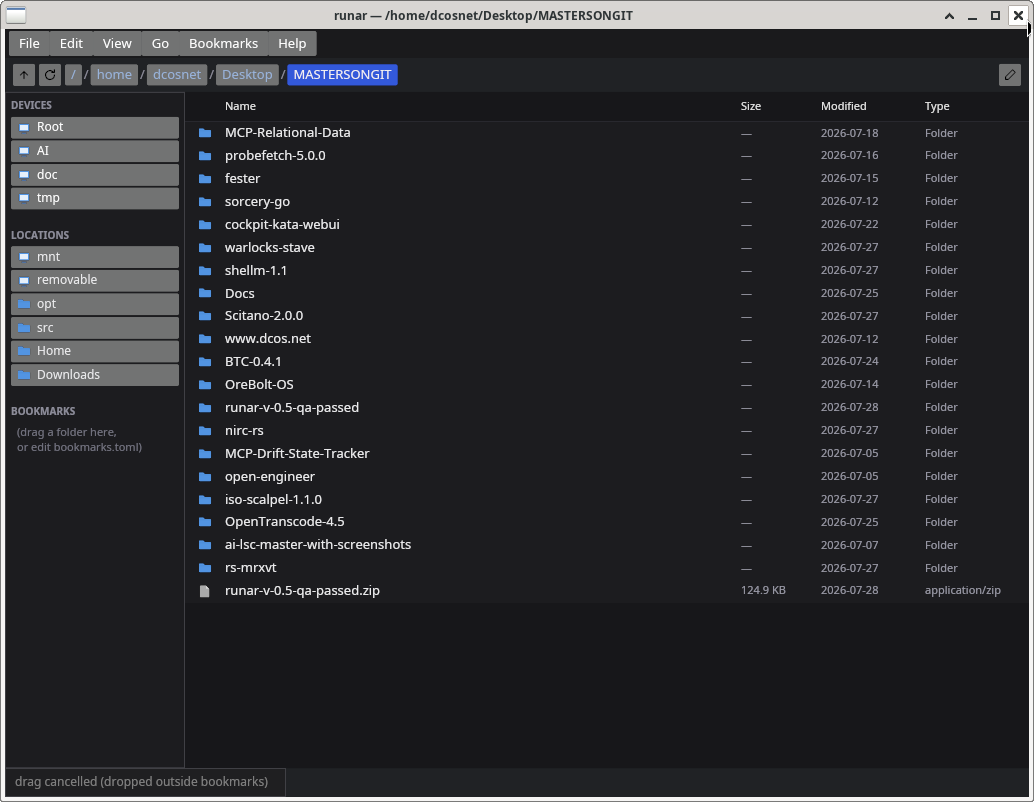
runar is a keyboard-first, statically-linkable Linux file manager written from scratch in pure Rust. It borrows its visual language from the dual-pane, breadcrumb-driven design of Thunar and PCManFM, while adopting ROX-Filer's AppDir paradigm and instantaneous, daemon-free MIME action hooks. The result is a single self-contained binary with no system library dependencies and no requirement for a desktop environment to be running. It targets power users who want a fast, predictable, scriptable file manager that respects the filesystem as the source of truth. The sidebar intentionally drops the conventional pile of hardcoded XDG user directories (Music, Pictures, Videos, Public, Templates) in favor of filesystem mounts, a small fixed set of power-user locations, and user-defined bookmarks — giving you a clean slate rather than a vendor-curated set of folders.
Screenshots are coming soon. The interface is composed of three primary regions: a breadcrumb pathbar at the top that can be toggled into a text input field, a three-section sidebar on the left (DEVICES, LOCATIONS, BOOKMARKS), and a scrolling file list on the right with icon, name, size, modified, and type columns. The look is intentionally minimal — inline SVG glyphs replace any system icon theme, so the same UI renders identically on a stock Arch install, a minimal Sway session, or a headless recovery image booted into a TTY with xinit. Until real screenshots land, the best way to see runar is to cargo run it.
Why runar?
runar combines the clean dual-pane/tree-and-grid layout of Thunar/PCManFM with the raw speed, AppDir capability, and lightweight MIME action hooks of ROX-Filer (the backbone of Puppy Linux and DSL). The sidebar strips out the conventional hardcoded XDG user directory sprawl — no Music, Pictures, Videos, Public, or Templates cluttering the view — in favor of filesystem mounts, a small fixed set of power-user locations (including $HOME and $HOME/Downloads as deliberate exceptions), and a fully user-editable Bookmarks section.
Conventional GTK-based file managers tend to bundle a pile of assumptions about the surrounding desktop: they expect a settings daemon, a volume monitor service, an icon theme, and a curated set of XDG user directories like Music, Pictures, and Public. runar throws those assumptions out. The only thing it assumes is a mounted /proc filesystem and a working Linux kernel, which means it runs equally well on a workstation, a server, a Raspberry Pi, or a recovery live USB. This design choice is deliberate: the file manager should reflect what is actually on disk, not what a desktop integration layer believes ought to be there.
The ROX-Filer lineage shows up most clearly in AppDir support and in the actions.toml MIME-hook system. AppDirs — directories that bundle an application together with its icons and resources, launched by executing an AppRun script or a same-named binary — let you install software by dropping a folder anywhere on the filesystem, no package manager required. The actions.toml file lets you bind any file extension, MIME glob, or exact filename to an arbitrary shell command, bypassing xdg-open entirely when you want finer control. Together these features restore the Unix philosophy of small, composable tools that the modern desktop has largely abandoned.
Features
runar is built around a small, deliberate feature set that prioritizes speed, predictability, and scriptability over visual flash.
- Pure-Rust, statically linkable binary — a single
target/release/runarexecutable with no shared library dependencies and no system icon theme requirement. - Keyboard-first navigation — Vim-style
H/J/K/Lplus arrow keys, with/or Ctrl+L to toggle the pathbar into edit mode and Enter to activate the selection. - Dual-pane visual language — breadcrumb pathbar on top, three-section sidebar (DEVICES, LOCATIONS, BOOKMARKS) on the left, and a scrolling file list on the right.
- ROX-Filer AppDir support — directories containing an
AppRunscript or a same-named executable are detected and can be launched as applications; Shift+Enter overrides this to enter them as directories. actions.tomlMIME hooks — bind any file extension, MIME glob (e.g.image/*), or exact filename to an arbitrary shell command, taking precedence overxdg-open.- Pure-Rust mount polling — replaces
gio::VolumeMonitorwith a direct/proc/mountsreader that filters out pseudo-filesystems and unescapes octal sequences in mount points. - Daemon-free sidebar — no settings daemon, no volume monitor service, no icon theme; the sidebar reflects actual filesystem mounts and user-defined locations only.
- User-editable bookmarks —
bookmarks.tomlis purely user-added, with no injected XDG defaults; the Bookmarks section starts empty. - Hardcoded power-user LOCATIONS —
/mnt,/var/run/media,/opt,/usr/src,$HOME, and$HOME/Downloadsare always present and complement the user bookmarks. - Inline SVG glyph set — every icon lives in
icons.rsas inline SVG, so the UI renders identically on any Linux install without depending on a system icon theme. - Atomic config saves —
bookmarks.tomlandactions.tomlare written via a temp-file-plus-rename pattern so a crash mid-write can never corrupt your configuration. - Async non-blocking VFS — directory scanning runs on a tokio runtime and streams results back to the UI, so even a directory with tens of thousands of entries never freezes the interface.
notify-based filesystem watcher — inotify events are bridged into a tokio channel and reflected in the grid automatically as files are created, modified, or deleted.
Why iced, not GTK4?
The project manifest originally proposed gtk4-rs. We switched to iced for the static-binary ethos: pure-Rust toolchain, no system lib deps (libgtk-4-dev, libglib2.0-dev, hicolor icon theme, etc.). A release build produces a single self-contained binary that runs on a fresh minimal Linux install.
Trade-offs:
- ✅ True static binary — no shared lib deps, no system icon theme required
- ✅ Pure Rust —
cargo buildjust works, nopkg-configgymnastics - ✅ Async-native Elm architecture — clean state/update/view separation
- ❌ No native cross-process DND (XDS) — in-app DND works, cross-process does not
- ❌ No
gio::VolumeMonitor— replaced with pure-Rust/proc/mountspoller - ❌ Immature at file-manager scale — untested at Nautilus/Thunar traffic levels
For runar's use case (power-user file manager, Linux-native, security-conscious), the static-binary win outweighs the ecosystem gaps. Shipping one binary that runs anywhere — from a fully loaded KDE Plasma desktop to a 50 MB SliTaz live image to a headless server reached over SSH with X forwarding — is worth more than native drag-and-drop into GIMP. The Elm-style state/update/view architecture that iced provides also maps cleanly onto a file manager's event loop: filesystem events, keyboard input, and UI clicks all funnel through a single update() function that mutates a single AppState struct, which makes the code easy to reason about and easy to test. The gaps that remain — cross-process DND, mature high-throughput list rendering, thumbnail pipelines — are explicitly tracked in the roadmap below and are the active focus of ongoing work.
Installation
runar builds with a stock Rust toolchain and no system dependencies beyond a working Linux installation with /proc mounted. You need Rust 1.70 or later on the stable channel; everything else is pulled in by Cargo as crate dependencies.
cargo run                          # debug build, opens at CWD
cargo run -- /some/path            # debug build, opens at /some/path
cargo build --release              # optimized static binary at target/release/runar
The release profile is already configured in Cargo.toml for a tight, stripped binary: opt-level=3, lto=fat, codegen-units=1, strip=symbols, and panic=abort. A release build typically takes one to three minutes on a modern laptop, since fat LTO and a single codegen unit trade compile time for a smaller, faster binary. The resulting target/release/runar is a single executable you can drop into /usr/local/bin, copy onto a USB stick, or ship inside a container image without any runtime library dependencies. For a fully static musl binary that has no dynamic linker requirement at all, add the musl target and rebuild:
rustup target add x86_64-unknown-linux-musl
cargo build --release --target x86_64-unknown-linux-musl
The musl variant is what you want for recovery images, initramfs payloads, and any environment where glibc may not be present or where you want the binary to run unchanged across distributions. Both the glibc and musl release binaries behave identically at runtime; only the libc ABI linkage differs.
Quick start
cargo run --release                # opens at your home directory
cargo run --release -- /etc        # opens at /etc
cargo run --release -- /mnt/data   # opens at a specific mount point
Once the window is up, press / or Ctrl+L to edit the path inline, type a new path, hit Enter to navigate, and use H/J/K/L or the arrow keys to move around the file grid. Drop a [[bookmarks]] stanza into ~/.config/runar/bookmarks.toml to pin frequently visited directories in the sidebar, and an [[actions]] stanza into ~/.config/runar/actions.toml to bind file types to your preferred editors and viewers. For a more detailed walkthrough — including how to set up AppDir shortcuts, how to write MIME-glob action rules, and how to integrate runar with a tiling window manager — see QUICKSTART.md.
Key bindings
runar is driven from the keyboard. Every navigation action has both an arrow-key binding and a Vim-style equivalent, so you can keep your hands in one place regardless of input preference.
| Key | Action |
|---|---|
Arrow Up / K |
move selection up |
Arrow Down / J |
move selection down |
H / Backspace |
go up one directory |
L / Enter |
activate selection (open / launch / navigate) |
| Shift+Enter | on an AppDir, enter it as a directory (overrides launch) |
/ or Ctrl+L |
toggle pathbar edit mode |
| Escape | exit pathbar edit mode |
The global keyboard handler lives in src/main.rs and dispatches into App::update() for state mutation. When the pathbar is in edit mode, the file grid ignores navigation keys so that typing a path does not move the selection. Shift+Enter on a directory that runar has detected as an AppDir will descend into it as a normal directory rather than executing its AppRun script, which is the escape hatch you need when you want to inspect an AppDir's contents rather than launch the application it bundles.
Configuration
Both of runar's configuration files live under ~/.config/runar/ and are created empty on first save. Neither file ever injects XDG defaults — the Bookmarks section starts empty, and the actions table starts empty, so xdg-open is the fallback for every file until you explicitly override it. The path is resolved through the standard XDG_CONFIG_HOME environment variable, falling back to ~/.config when unset, exactly as the XDG Base Directory Specification requires.
bookmarks.toml
Bookmarks are purely user-added entries that appear in the BOOKMARKS section of the sidebar, below the hardcoded LOCATIONS. The label field is optional; when omitted, runar falls back to the basename of the path.
[[bookmarks]]
path = "/mnt/data"
label = "Data"  # optional
actions.toml
Actions bind a pattern to a shell command (or a chain of fallback commands). The pattern may be a bare file extension (with or without a leading dot), a MIME glob such as image/*, or an exact filename like Makefile. The {} placeholder in command is substituted with the shell-quoted absolute path of the matched file, and the resulting command line is executed via sh -c. The first matching action wins, so order your rules from most specific to least specific.
Single-command form (simplest):
[[actions]]
pattern = "txt"
command = "foot -e vim {}"

[[actions]]
pattern = "image/*"
command = "feh {}"

[[actions]]
pattern = "Makefile"
command = "make -C $(dirname {})"
Fallback-chain form — try each command in order, succeed on the first whose binary is on $PATH. Useful when you want a preferred tool but a graceful fallback for systems where it isn't installed:
[[actions]]
pattern = "txt"
commands = ["scitano {}", "scite {}", "geany {}", "nano {}"]

[[actions]]
pattern = "image/*"
commands = ["feh {}", "sxiv {}", "xdg-open {}"]
If every command in the chain fails the $PATH check, runar falls through to the built-in MIME table, then to xdg-open. The chain is checked statically (we parse the leading binary name from each command string and verify it exists on $PATH before spawning) so a missing binary doesn't pay the cost of a failed sh -c invocation.
Both files are written atomically on save: runar writes to a sibling temp file and then renames it over the original, so a crash or power loss mid-write cannot leave a half-written config behind. The config engine has unit tests covering roundtrip serialization, the fail-soft behavior when a config file does not exist yet, and the precedence rules for actions.toml patterns.
Default locations
The LOCATIONS section of the sidebar contains a small, hardcoded set of power-user directories chosen by the author. These are always present and cannot be removed by editing bookmarks.toml; they complement the user-editable Bookmarks section rather than competing with it.
/mnt— traditional mount point/var/run/media— udisks2 auto-mount point (systemd systems)/opt— optional software packages/usr/src— kernel sources / build trees$HOME— user's home directory$HOME/Downloads— downloads folder
This list reflects a deliberate bias toward systems administration and power-user workflows: /mnt and /var/run/media are where removable media and network mounts actually appear on a modern Linux box, /opt and /usr/src are where hand-installed software and kernel build trees live, and $HOME plus $HOME/Downloads cover the day-to-day user directories without forcing Music, Pictures, Videos, Public, and Templates into your sidebar. If you want additional shortcuts — a project directory, a media library, a network share — add them to bookmarks.toml and they will appear in the BOOKMARKS section right below these defaults. The split between hardcoded LOCATIONS and user-editable BOOKMARKS keeps the sidebar visually stable across config changes while still letting you customize it freely.
Architecture
runar is organized into a thin UI layer over an async VFS core, with configuration and launch dispatch factored out into standalone modules. The split makes it straightforward to unit-test the filesystem, config, and launch logic without ever instantiating the iced runtime.
src/
  main.rs              iced entry point + key-press bridge (raw Key/Modifiers → Message)
  date.rs              Howard Hinnant civil_from_days algorithm (leap-year-correct date math, no chrono)
  vfs/
    mod.rs             async scan_directory (Phase 1 — non-blocking tokio directory reader)
    appdir.rs          ROX AppDir detection (AppRun or same-name executable)
    watcher.rs         notify-based inotify watcher, bridged to tokio channel
  config/
    mod.rs             Config struct, atomic save, XDG path resolution (~/.config/runar/)
    bookmarks.rs       bookmarks.toml (purely user-added, no XDG defaults)
    actions.rs         actions.toml (extension/MIME → shell command overrides)
    defaults.rs        Hardcoded default locations shown in sidebar LOCATIONS section
  mounts.rs            /proc/mounts poller + pure parse_mounts() (replaces gio::VolumeMonitor)
  icons.rs             Inline SVG glyph set with cached LazyLock<Handle> per variant
  mime.rs              Built-in default MIME action table (text→$EDITOR, image→$IMAGE_VIEWER, etc.)
  launch.rs            Launch dispatcher: AppDir exec → actions.toml → built-in MIME → xdg-open
  ui/
    mod.rs             App state, update(), view(), subscription(), handle_key()
    pathbar.rs         Breadcrumb view, toggleable to text input via / or Ctrl+L
    sidebar.rs         Three sections: DEVICES, LOCATIONS, BOOKMARKS
    grid.rs            Scrolling file list with icon/name/size/modified/type columns (mouse_area for right-click)
    menubar.rs         Top menubar (File/Edit/View/Go/Bookmarks/Help) + dropdown panels
    context_menu.rs    Right-click context menu with type-aware entries per file kind
    about.rs           About dialog (Help → About runar)
The vfs module is the heart of the project: scan_directory runs inside a tokio runtime and streams Entry records back to the iced subscription loop, so the UI thread never blocks even when scanning a directory containing tens of thousands of files. The appdir submodule classifies each directory entry as either a plain directory, an AppDir (containing an AppRun script or a same-named executable), or a regular file, which the launch dispatcher uses to decide what to do when you press Enter. watcher.rs wraps the notify crate's inotify backend and bridges events into the same tokio channel, so changes from other processes — git pull, a download finishing, a USB stick being mounted — show up in the grid automatically. Configuration is split across mod.rs, bookmarks.rs, actions.toml, and defaults.rs, each responsible for one file or concept, and mounts.rs handles /proc/mounts parsing independently of any desktop volume monitor. The ui module is intentionally thin: mod.rs holds the AppState struct and the update/view/subscription trinity, while pathbar.rs, sidebar.rs, and grid.rs are pure view functions that turn slices of state into iced widgets.
Testing
runar ships with 83 unit tests, all passing. Run them with:
cargo test --bin runar
The test suite covers every non-UI module and is structured to mirror the source tree, so each module's tests live alongside its implementation in a #[cfg(test)] mod tests block. Tests are deterministic, do not mutate process-global state (no std::env::set_var calls — overrides are threaded through function parameters instead, which avoids both parallel-test flakiness and the unsafe requirement that Rust 1.82+ imposes on env mutation), and do not touch the real filesystem for writes: where a temp directory is needed, the tests use std::env::temp_dir() and clean up after themselves. The full breakdown:
- date::tests::* — Howard Hinnant
civil_from_daysalgorithm: epoch anchors, leap-year handling (1972 leap, 1973 non-leap, 2000 leap despite div-by-100, 1900 and 2100 non-leap), pre-epoch dates, Y2K rollover,format_dateshape (14 tests) - mime::tests::* — built-in default MIME action table: text→editor chain (scitano→scite→geany→nano, $EDITOR first), image→$IMAGE_VIEWER, video/audio/PDF→xdg-open-with-env-override, HTML→$BROWSER (checked before text/ rule), archives→
ls -l, JSON/YAML/TOML/XML→editor, shellscript→editor, editor chain ordering, $EDITOR precedence, unknown MIME returns None, charset-suffix stripping, path-based resolution (17 tests) - config::tests::* — config load/save roundtrip, missing-config fail-soft,
config_dir_withpath composition (3 tests) - config::bookmarks::tests::* —
bookmarks.tomlroundtrip (1 test) - config::actions::tests::* — pattern matching (extension, dot-prefix, MIME glob, exact filename), single-command form, fallback-chain form,
commands_to_tryordering (chain wins over single), empty action, TOML roundtrip for both forms, TOML parsing of both forms (12 tests) - config::defaults::tests::* — hardcoded locations include
/mnt/opt/usr/src/var/run/media,$HOMEand$HOME/Downloadsresolution when home provided, omission when home isNone, total count (4 tests) - launch::tests::* —
shell_quote(simple paths, paths with spaces, paths with single-quotes),extract_leading_binary(simple, env assignment, env-var expansion returns None, empty,sh -c),binary_on_path(finds sh, rejects nonexistent, handles absolute path) (11 tests) - vfs::tests::* — directory scan reports done (1 test)
- vfs::appdir::tests::* —
AppRundetection, same-name executable detection, plain dir rejection (3 tests) - mounts::tests::* —
/proc/mountsparsing (sample input, pseudo-FS filtering, network FS tagging, dedup, empty input, malformed lines), octal escape unescaping (spaces, tabs, backslashes), UTF-8 preservation in mount labels (9 tests) - icons::tests::* — all variants have distinct SVG markup, widget construction doesn't panic (2 tests)
The shell_quote tests in launch.rs are particularly important because they are the only line of defense between user-controlled filenames and sh -c. They assert that paths containing spaces are wrapped in single quotes, that paths containing single quotes themselves are escaped correctly using the '\'' idiom, and that simple paths without special characters are passed through unchanged. The actions.toml tests verify the four pattern-matching strategies — bare extension, dotted extension, MIME glob, and exact filename — so that the precedence rules documented in the Configuration section above are enforced by code rather than by convention. The mounts tests cover both the happy path of parsing a typical /proc/mounts line and the edge case of mount points containing octal-escaped characters like \040 for a space, which the kernel uses to disambiguate the whitespace-separated mount table format.
Roadmap
runar is feature-complete for daily power-user use, but several capabilities that desktop users expect from a Thunar-class file manager are still on the way. The phases below track what is done and what is queued for the next several release cycles.
- Phase 1: Core engine & async VFS (scanner, watcher, AppDir detector)
- Phase 2: Shell layout (pathbar, sidebar, file grid, keyboard nav)
- Phase 3: Launch dispatcher (AppDir exec, actions.toml, built-in MIME table, xdg-open fallback)
- Phase 4: Config engine (bookmarks.toml, actions.toml, atomic save)
- Background copy/move/delete with progress toasts
- True multi-column icon grid with spatial H/J/K/L navigation
- Virtualized file list (iced 0.13's stock
scrollablelays out all children; page or custom-widget the entry list for 10k+ entries) - Cross-process drag-and-drop (XDS — currently limited to in-app)
- Thumbnail rendering (will need to add the
imagecrate as a dependency) - File permissions dialog
- Bulk rename tool
- Bookmark editor UI (currently edit bookmarks.toml by hand)
The completed phases cover everything you need to browse, navigate, and launch files. The remaining items fall into two buckets: filling in file-management operations that every file manager needs (background copy/move/delete, permissions dialog, bulk rename) and pushing the UI closer to parity with Thunar and ROX-Filer (spatial icon grid, thumbnails, cross-process DND). The thumbnail pipeline is the lowest-hanging fruit in concept but will require adding the image crate as a dependency (it is not currently in Cargo.toml) and wiring a thumbnail cache into the grid renderer alongside the existing rayon pool. The cross-process DND item is the hardest, because XDS support in pure Rust effectively does not exist today and will likely require either an FFI shim to libX11 or a from-scratch implementation of the XDS protocol on top of a pure-Rust X11 client. Pull requests targeting any of these items are very welcome.
Credits and inspiration
Design inspiration (no code copied)
- Thunar (Xfce) — dual-pane layout, breadcrumb pathbar, keyboard-first navigation
- PCManFM (LXDE) — lightweight GTK file manager philosophy
- ROX-Filer — AppDir paradigm, instant MIME action hooks (no DE daemon dependency)
- Puppy Linux / DSL — ROX-Filer as desktop backbone, AppDir application bundles
- SliTaz — minimal-footprint philosophy, fast boot from read-only media
Code reuse
No code was copied from any of the above projects. runar is a clean-room implementation. The Rust crates used (iced, tokio, notify, mime_guess, serde, toml, rayon, walkdir, open) are each credited in Cargo.toml and remain under their respective licenses.
Author
Jeremy Anderson info@dcos.net — https://git.dcos.net/dcosnet/runar
Contributing
Patches welcome at https://git.dcos.net/dcosnet/runar (see repository for issue tracker and merge request workflow).
Building from source requires Rust 1.70+ (stable). No system dependencies beyond a working Linux installation with /proc mounted.
The contribution workflow is intentionally lightweight: fork the repository, branch off main, write code that passes cargo test --bin runar and cargo clippy -- -D warnings, and open a merge request with a clear description of the change and the motivation behind it. New features should ship with unit tests in the same #[cfg(test)] mod tests style as the existing code, and any new user-visible string should be plain ASCII (Unicode is fine where it makes sense, but avoid emoji in the UI itself). If you are adding a new keyboard binding, document it in the Key bindings table in this README and update the global keyboard handler in src/main.rs in the same commit. If you are touching the launch dispatcher or the actions.toml parser, add a test case to launch::tests or config::actions::tests that exercises the new behavior, since those code paths are the boundary between user-controlled input and sh -c and need the most rigorous coverage.
License
GPL-2.0-only — see the LICENSE file for details.