 dcosnet
cd019699d1
dcosnet
cd019699d1
|
||
|---|---|---|
| scripts | ||
| src | ||
| tests | ||
| BLOG.md | ||
| Cargo.toml | ||
| FIX-NOTES-glyphfix.md | ||
| FIX-NOTES-indoc-links.md | ||
| MANIFEST.md | ||
| QUICKSTART.md | ||
| README.md | ||
| TODO.md | ||
| corbel-purge-ss.png | ||

README.md
CorbelPurge
Strict Rust document sanitizer & threat neutralizer for PDF, EPUB, Markdown, and DOCX.
Author: Jeremy Anderson — dcos.net — info@dcos.net Repository: https://git.dcos.net/dcosnet/corbel License: GPL-3.0-or-later
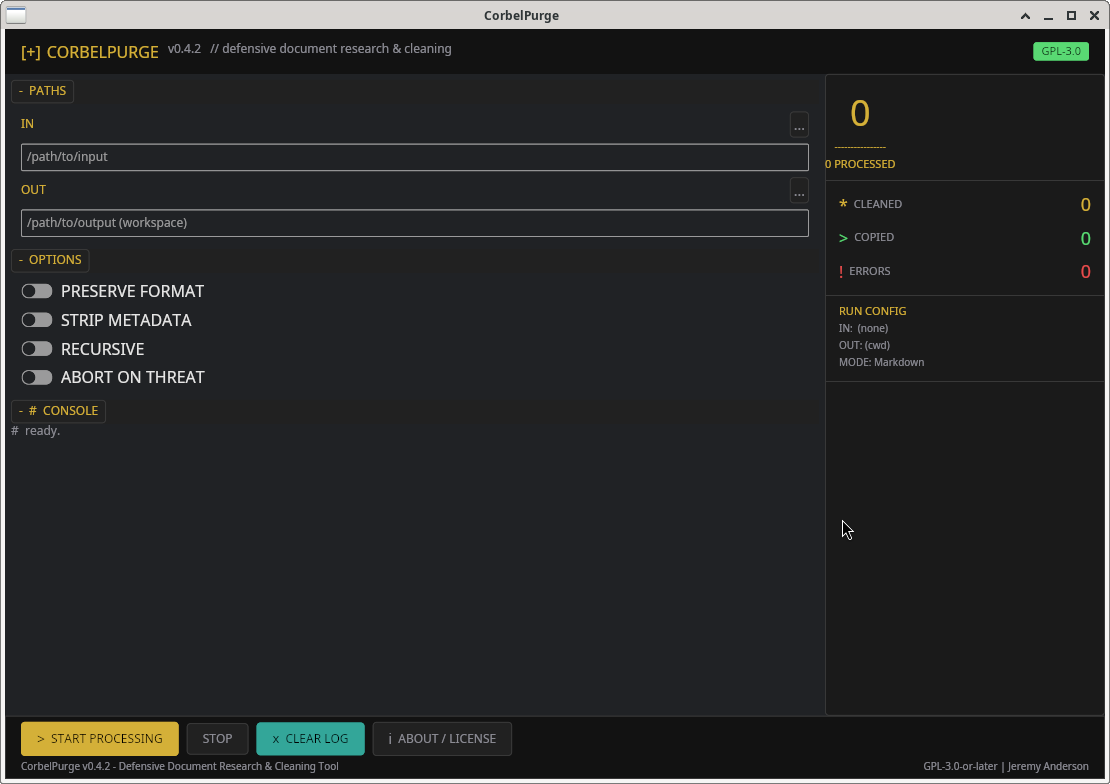
Overview
CorbelPurge is a strict, local-only document security scanner. It parses documents into a unified intermediate representation, runs detectors that are backed by verifiable properties of the bytes on disk, and produces cleansed derivatives with all executable content stripped. Malicious payloads are carved into quarantine tarballs with full forensic reports.
The scanner is built around a single design invariant: every detector must be backed by a verifiable property, either of the document itself or of an external authority. No thresholds, no per-file or per-domain exceptions, no statistical "suspicious" tier.
What it does
Given a file path, Pipeline::run() in src/core/pipeline.rs:
- Detects format via
DocumentFormat::from_path()(extension-based:.pdf,.epub,.md/.markdown,.docx). - Parses via
parsers::Dispatcherinto aDocumentcontainingTextNode(static text with semantic context) andExecutableVector(active content like JS streams, embedded files, script tags, VBA macros) items. - Scans with a two-pass engine:
heuristics::inspect_vector()classifies every executable vector against the two-category detector model: Category 1 (verifiable executable intent — file signatures, shellcode prologues, executable URI schemes) and Category 2 (verifiable impersonation — exact-host homographs, credential URLs, mixed-script hosts).context_filter::evaluate()checks text nodes for structural signatures (/JavaScript,<script, etc.) and weaponization indicators (long hex runs, base64 blobs, multi-shell commands). Words and function names that appear in legitimate technical literature (wget,exploit,payload,eval() are not treated as signatures.cve_tags::match_cve()annotates findings with known exploit IDs.
- Reports — both clean and malicious scans produce a JSON and
Markdown report in
corbel_quarantine/namedreport_<timestamp>_<sha_prefix>.{json,md}. The clean path provides an audit trail; the malicious path adds a quarantine tarball and carved payloads. - Quarantines (when malicious findings exist) —
quarantine::handle()carves payloads intoquarantine_<ts>_<sha>.tar.gzwithoriginal.<ext>,report.json,report.md, and one.binper payload (plus paired.hexand.infofiles). - Cleanses (when recommended) — produces a sanitized derivative:
- Markdown mode (default):
cleanse::sanitizer::sanitize()emits a safe Markdown file. Text nodes at malicious locations are stripped; hyperlinks lose their destinations. - PreserveFormat mode (
--preserve-format):cleanse::repackage::repackage()rebuilds the original format with malicious entries removed. EPUB entries are stripped from the ZIP, DOCX macros/embeddings/external-links are removed, PDF objects are deleted via lopdf.
- Markdown mode (default):
- Clean-output (when scan is clean and
emit_clean_outputis on, the default) — copies the source file tocorbel_clean/clean_<ts>_<sha>.<ext>so the scanner acts as a pipeline stage. Use--move-cleanfor queue-draining semantics.
Supported formats: PDF, EPUB, Markdown, DOCX.
Detection model
Two categories. Nothing else fires.
Category 1 — Verifiable executable intent
The vector contains a structure whose only purpose is to execute code or spawn a process. Presence is the threat.
| Detector | Triggers on |
|---|---|
| Active script in PDF | /JavaScript or /JS action stream |
| Program launch in PDF | /Launch action with /F, /Win, /Mac, /Unix |
| External program exec in EPUB | <script> tag in XHTML |
| VBA macro in DOCX | word/vbaProject.xml present in package |
| Executable embedded file | Bytes match a known executable magic (MZ, ELF, Mach-O, OLE2, RTF, SWF, LNK, HTA, VBA stubs) at offset 0 |
| Executable URI scheme | javascript:, vbscript:, data:text/html, file: in a hyperlink or action |
PDF form with /AA |
AcroForm dictionary contains the /AA (Additional Actions) entry |
PDF widget with /AA |
Widget annotation with /AA entry |
| Shellcode prologue | Known Metasploit / NOP-sled / syscall-stub byte sequences |
Category 2 — Verifiable impersonation
The vector lies about identity in a way that is provably wrong.
| Detector | Triggers on |
|---|---|
| Exact-host homograph | URL authority byte-equal (after ASCII case-folding) to a known homograph string (micros0ft.com, paypa1.com, etc.) |
| Credential URL | RFC 3986 authority component contains user:pass@ (before the first / after ://) |
| Mixed-script host | URL host mixes Latin with Cyrillic or Greek (a property of the codepoints) |
What is NOT a detector
The following were removed because they are statistical guesses about the world, not verifiable properties of the document:
- Substring keyword matching — words like
login,verify,support,accountare not threats. Every legitimate login page contains them. - Phishing TLDs —
.ru,.cn,.xyzare not threats. A Russian URL is a Russian URL. - URL shorteners as a threat signal —
bit.lyis not a threat. If the destination is hostile, the underlying detector catches it. - Substring brand matching —
https://github.com/microsoft/vscodeis not a threat. The host isgithub.com; the brand substring in the path is irrelevant. - IP-address hosts —
192.168.1.1is a valid network address. RFCs and router manuals reference them. - Substring text-node signatures — words like
wget,exploit,payload,eval(,powershell,/bin/shin prose are not threats. Only structural tokens (/JavaScript,<script,shellcode) and weaponization indicators (hex runs, base64 blobs, multi-shell commands) fire.
Pipeline architecture
input path ──► parser ──► Document (UIR)
                                 │
                                 ▼
                              scanner ──► ScanReport
                                 │
            ┌────────────────────┼────────────────────┐
            │                    │                    │
            ▼                    ▼                    ▼
        (clean)              (malicious)          (educational)
            │                    │                    │
            ▼                    ▼                    ▼
    clean_<ts>_<sha>.<ext>  quarantine tarball   whitelisted
    + report.json / .md     + carved payloads    (logged only)
                            + cleansed file
Library usage
use corbel_purge::{Pipeline, Config, CleanseMode};

// Scan a file on disk
let pipeline = Pipeline::with_config(Config::with_workspace("/tmp/output"));
let result = pipeline.run("suspicious.pdf")?;
println!("malicious: {}", result.scan_report.malicious_count());

// Scan in-memory bytes (e.g. from an email gateway)
let bytes = std::fs::read("upload.docx")?;
let result = pipeline.run_on_bytes(
    bytes,
    corbel_purge::DocumentFormat::Docx,
    Some("upload.docx".into()),
)?;

// PreserveFormat mode
let mut config = Config::default();
config.cleanse_mode = CleanseMode::PreserveFormat;
let pipeline = Pipeline::with_config(config);
let result = pipeline.run("book.epub")?;
Source layout
src/
├── main.rs                  # CLI: scan, scan-dir, study, --version, arg parsing
├── lib.rs                   # Crate root, CorbelError enum, public re-exports
├── util.rs                  # sha256_hex(), truncate_with_ellipsis(), read_with_cap()
├── bin/
│   └── gui.rs               # iced 0.13 dashboard GUI (gui feature)
├── core/
│   ├── types.rs             # Document, TextNode, ExecutableVector, Finding, ScanReport,
│   │                         # Location, TextContext, VectorType, ThreatClassification,
│   │                         # MaliciousType, Recommendation, DocumentMetadata
│   ├── config.rs            # Config, CleanseMode, env overrides, workspace dirs
│   └── pipeline.rs          # Pipeline, PipelineResult, DocumentFormat::from_path()
├── parsers/
│   ├── mod.rs                # DocumentParser trait, Dispatcher
│   ├── pdf_parser.rs         # lopdf-based PDF structure walker
│   ├── epub_parser.rs        # ZIP-based EPUB container inspector
│   ├── md_parser.rs          # pulldown-cmark text extractor
│   └── docx_parser.rs        # OOXML ZIP inspector (regex XML extraction)
├── scanner/
│   ├── mod.rs                # scan() entrypoint, CVE tag injection
│   ├── heuristics.rs         # classify_vector() — two-category detector model
│   ├── context_filter.rs     # evaluate() — structural signatures + weaponization
│   ├── signatures.rs         # KNOWN_FILE_SIGNATURES, SHELLCODE_PATTERNS,
│   │                         # HOMOGRAPH_HOSTS, URL_SHORTENER_DOMAINS (retained
│   │                         # for future reputation work, not consulted)
│   └── cve_tags.rs           # CVE_TABLE, match_cve(), cve_tag()
├── quarantine/
│   ├── mod.rs                # handle() — tarball writer, write_clean_report()
│   ├── extractor.rs          # extract_payloads(), ExtractedPayload, filename sanitization
│   ├── hexdump.rs            # hex_dump(), build_payload_info()
│   └── reporter.rs           # build_json_report(), build_markdown_report()
├── cleanse/
│   ├── mod.rs                # cleanse() dispatcher (Markdown vs PreserveFormat)
│   ├── sanitizer.rs          # sanitize() — Markdown re-serializer
│   └── repackage.rs          # repackage() — format-preserving (EPUB/DOCX/PDF)
└── ui/
    ├── mod.rs                # GUI module gate (behind `gui` feature)
    ├── viewer.rs              # Stub
    └── alert_modal.rs        # Stub
Design philosophy
- Verifiable properties only. A detector either proves a finding by a property of the bytes, or it doesn't fire. No thresholds.
- No special-casing. No per-file or per-domain exceptions. The clean-document guarantee is a theorem about the detectors, not an empirical observation about one specific file.
- Unix philosophy. Each module does one thing. The pipeline is a linear sequence of small steps. Step-down logic (early returns) for every fork of choices.
#![forbid(unsafe_code)]at the crate root. The scanner never touchesunsafeRust.- Local-only. No network access during scanning. All analysis is against the bytes on disk. External threat-intel feeds are loaded from local JSON files at startup.
Adding a new format
- Create
src/parsers/<format>_parser.rsimplementingDocumentParser. - Add a variant to
DocumentFormatinsrc/core/types.rs(and itsDisplayimpl). - Add a match arm in
Dispatcher::parse()insrc/parsers/mod.rs. - Add an extension check in
DocumentFormat::from_path()insrc/core/pipeline.rs. - Add repackage support in
src/cleanse/repackage.rs(optional).
The scanner, quarantine, and cleanse modules consume only the
Document UIR and require no changes for basic format support.
Non-goals
- No document editing or annotation.
- No execution of embedded scripting (PDF JS, EPUB scripts, VBA macros).
- No network access during scanning — all analysis is local.
- No sandbox hardening of the tool itself.
Documentation
- QUICKSTART.md — Build guide and operator reference
- MANIFEST.md — Detailed technical specification
- TODO.md — Development roadmap
- FIX-NOTES-false-positive-redesign.md — Design notes for the two-category detector model
- FIX-NOTES-indoc-links.md — In-document link handling
- FIX-NOTES-glyphfix.md — Glyph rendering fixes
License
GPL-3.0-or-later. Copyright (c) 2026 Jeremy Anderson. https://git.dcos.net/dcosnet/corbel